Tuesday, November 11, 2014

Blog #9 Solitude & Thanksgiving

We began the week with a 40-hour solo at a sit spot. It was hard and wonderful and weird to spend almost two days outside, without food or company, after being together every day for nine weeks. It was a beautiful time to look inward, to reflect, and to listen to the silence. For those two days we felt the sun’s first rays announcing the longed for morning and traced its path through the stormy sky. We learned about ourselves, and many of us found new strength for the future. When we came back together we came into the noise and activity of life slowly. Now we carry the quiet solitude of our solo experiences with us into the next stage of our journey.

From there we moved onto crafts and academics. We had a multitude of semester book pages to complete, new prompts to write on in our journals, old crafts to finish and new crafts to begin. Roberto joined us from San Clemente to lead us in making leather bags big enough to hold our semester books. On Wednesday we began work on Mathias’ beautiful home, and hopefully will finish the upstairs walls before we leave for expedition so that Mathias, Nicole and Ayra can move in.

Thursday began normally with work on our leather bags and construction on the house. Then at lunch we learned that Nadino, our beloved leader, would be returning to the jungle. On Friday morning we said goodbye to him and even Michael’s class exploring tunnels and caves failed to cheer us up. Now we are all processing it better, and will carry Nadino along with us in our hearts.

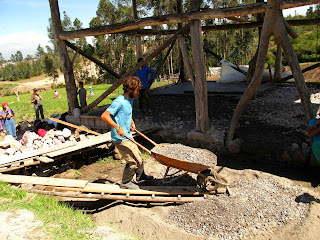
Saturday we spent the morning in the town of Palugo helping Wicho’s family pour the floor for Wicho’s future home. Wicho had already built the bare bones structure and roof himself, and it will be a beautiful home when it is finished. It was a wonderful experience to work alongside brothers and sisters, nieces and nephews to build something beautiful together. By mid-afternoon the house had a strong cement floor and we had learned how to mix cement by hand, how to make the world’s best empanadas, and how to work together in a new community. We left with two turkeys which Wicho’s mother was thrilled to part with and which we slaughtered right then. It was a powerful experience to watch those magnificent birds go from walking around to plucked and ready to be baked.

Yesterday we roasted the turkeys for an early Thanksgiving celebration since we will just be getting back from expedition on the real Thanksgiving. Preparations for the meal began at 4:30 am, baking in the wood-burning bread oven and cooking over an open fire and by 5pm we had a beautiful Thanksgiving feast. We managed to fit in a fascinating permaculture class about microorganisms with Thomas to boot. That night along with family and friends here at Palugo we stuffed ourselves on turkey, chicken, mashed potatoes, gravy, sweet potatoes with marshmallows, stuffing, beets, green beans and carrots with almonds, green salad, and countless pies, cheesecakes and other deserts baked in the bread oven. It was fantastic, and we will be eating leftovers for days in the true spirit of the holiday.

Hasta Luego,

Mary Kate


Reflections:

Silence

Silence is a rare commodity in our overwhelming world. It is not often we find ourselves in solitude, with nothing to entertain or distract. A silence so powerful you can hear the beat of your heart, your steady breathing, the rhythm of your life. It is in these moments we can take time to truly and fully look inside ourselves. Not only to understand our weaknesses but also our strengths, so we can know ourselves completely, and learn to love and accept who we are. It’s important to recognize the necessity of these moments; otherwise a lifetime can go by without ever taking the time to solidify your sense of self. Always putting your energy outward and never growing within. Silence can create an atmosphere for happiness or sadness, weakness or strength, but above all silence fosters knowledge.
~ Harrison


La Celva

Hot, slow and sticky,
Drip,
Sweat into sleep,
Blink,
Lifetimes pass,
Flash,
Night is illuminated,
Thunder,
Storms begin,
Deluge,
All is water,
All is alive.

~ Isaiah

What it Means to Make a Living

Making a living means to make a life for yourself, to do what you feel is right with everything that you do. Doing what makes you happy, but what is also beneficial to the Earth and other living beings. For example, you might love fracking, but is it beneficial to other living beings? Temporarily maybe to some humans but in the long run? ABSOLUTELY NOT! Is Mother Earth okay with it? You didn’t even ask her. Therefore fracking is not making a living, it is making a death. If you live in connection with everything and live consciously and happily, you are making a living. If you are open-minded and kind, you are making a living.


~Bethany


Amy at work


Emma working with leather.


Wednesday, October 29, 2014

Blog # 8: We’re back from our first expedition in Ecuador!

It’s crazy to think that we are already halfway through this journey together, and that we have finished our longest expedition. It was exciting, exhausting and absolutely amazing.

We began the last section with a 37 km leg of biking which somehow was the hardest day yet, with Laura struggling through an upset stomach, Harrison getting about five flat tires, the heat, and overall low group energy. We did however see a double rainbow!

Despite our many delays and breaks we made it to La Serena in plenty of time. Our campsite was across a very long footbridge from the road, so we spent the evening portaging all our river gear from the truck to our camp and then spent the next morning bringing our bike gear back across the river to the truck. The rest of the morning was spent practicing using throw ropes, swimming in the Rio Jatunyacu, and preparing the cataraft, kayaks and little white raft affectionately called the schnitzel for the journey. In the afternoon it poured as it does only in the jungle. Just as the rain began to slow down we went up the river a bit to take some solo reflection time on the most gorgeous beach I have ever seen. Across the river a cliff covered in green leaves and jutting rocks rose above us and all around us the mist from the rain was rising and the mountains were reaching up into the far off storm clouds. We spent the night in La Serena again and left on the rafts the next morning led by Thomas, Ango, Nicole, Laurel and Nadino. Parts of the river were reasonably calm, parts were very rough and turbulent, and all of it was hot and sunny and beautiful. At one point our river joined into the Rio Napo, one of the main rivers that creates the Amazon. We arrived at our next camp in the early afternoon after flipping the schnitzel raft only once and spent the afternoon working on kayak skills and practicing flipping. That night we slept on the beach, grateful for our tents to keep the jungle bugs away and to provide some separation from the sand.

Our next campsite, 25 kms down the river was even more beautiful, tucked away under the trees where the riverbank met the jungle, surrounded by the sounds of the rainforest.

On Monday we took apart the cataraft, and sent everything possible back to Palugo so that we could hike through the jungle into the community of Shiwacocha. We said goodbye to Ango and Thomas and were rejoined by Mathias and Ayra. It was amazing for us to contrast the grassy highlands of the weeks before with the hot, humid, buggy rainforest as we hiked. The leaves were bigger than Ayra, the sounds so distinctly rainforest-y and everywhere were plants competing for sunlight.

In the late afternoon we made it to our final destination: the home of Isolina, Nadino’s mother. She fed us yucca and plantain, sang with us, and sent us to sleep on mattresses in a beautiful room on stilts. We spent the next two days hauling sand and carrying wood to various houses to help out, swimming in the Arunjuno river, munching on sugar cane, getting eaten alive by ants and immersing ourselves in such a totally different culture. With Nadino’s grandfather and uncle we made baskets (which frustrated some of us more than others) and with Isolina we made traditional pilche bowls out of the fruit that grows from the Pilche tree. Our last night in the jungle we learned the traditional dance of the Quechua, the biggest indigenous culture in Ecuador.

They next morning we were up at 3:30 to experience morning in the jungle and to prepare to leave. Some of us also chose to put hot peppers in our eyes as a traditional way of gaining clearer sight, literally and figuratively, and it can only be done in the early morning when the day is cool and the peppers less potent. After breakfast on Friday we said goodbye to Shiwacocha and all 19 of us piled onto the reassembled cataraft to float down the river to where we could get a bus back home. It took most of the day since none of us really felt like paddling and instead we spent the time floating on balsa logs or on the tube pulled behind the raft.

We took apart the cataraft one last time to get it on the bus, and then all piled in for the five hour ride up the Andes and back to Palugo.

Today we are cleaning up from expedition, sorting gear, and decompressing after the high energy of the last 25 days. Tomorrow we will close this chapter of Semester and switch gears to crafts and academic work for the next few weeks.

Hasta Luego,
Mary Kate

Distance traveled this leg: 105km
Total Distance for the whole Expedition: about 450 to 473km


Reflections

The Jungle
I can remember drawing the colorful layers of the jungle in 4th grade with pencils on my main lesson paper. I remember using browns and dark greens and some reds to carefully draw in each layer from earthen floor to high canopy. I didn’t know if I would ever actually visit the jungle but now I am here. It is alive and different but certainly not as organized as my page drawing. Here the forest floor crawls with insects of all shapes and sizes, insects so foreign to me I am wary when our paths cross. Here the trees are laced with vines and the leaves are ten times bigger than any leaf at home. I cant decipher the separate layers from which the forest grows, the floor crawls into the middle layers of small trees and shrubs and from there up to the higher reaches of the canopy and finally to the wheeling birds in the changing sky. The jungle sings and moves constantly to its own heartbeat.
~ Elsbeth


Sometimes we need to sit down and look and the mountains and wonder
and hope to be inspired
Hope to be inspired be the quiet greatness of things which are
The greatness of vast expanses of lakes, fields, and the heights of
mountains
And like it came the falling of my soul, a blade of grass in a sea of green.
Quiero ser mas paciente
I fell into my deep dream
I spiraled into the night
Until I unfound myself amidst the stars
and found myself again
watching the stars
For we are the manifestations of the wisdom that is the universe.
The day will end.

~ Group poem, each line written by a different person


Sunday, October 26, 2014

We made it over the Andes!

We made it over the Andes! 

Since the last blog post we’ve biked 200+ kilometers across the mountains and are by now sitting in Ashanga, a thatched roof over our heads and jungle all around us.

We left for our next stage of expedition with a beautiful downhill trail. After a short back track on cobblestone roads we passed our pre-San Clemente soccer field campsite in Zuleta, and biked (or pushed our bikes) up very muddy, very, steep hills. Upon reaching a nice plateau the road ended and we decided to bushwalk. In theory the road we wanted was just over the next hill, but after bravely pushing our bikes through branches and thorns for almost two hours, we were forced to turn around and bike all the way back to our former Zuleta soccer field. It was rainy. And muddy. And dark. And cold. It was all looking pretty dreary until the president  of the community stopped by and lend us the community house for the night. It was beautiful, with a huge kitchen and magnificent wood stair case leading to an open upstairs. After such a though day of futile, muddy biking we felt as though we have landed in a warm, welcoming paradise. 

The next morning we set out early to catch up from our detour the of the day before.  Thirty-five uphill, rainy kilometers later we were biking up to Bernardo’s beautiful house complete with soup and Mathias, Nicole and Ayra to welcome us. After filling our bellies with food and warming our bodies by the fire we slept all cuddled up by the covered porch. Saturday morning we said goodbye to Nicole and Ayra for the next leg and set off into the mountains. That night we camped next to Rio Pisambilla in the windy highlands and the rain miraculously cleared to offer us our first sun all day.

Sunday, we slept in a bit and set off, biking up, and up and up. We ate a good lunch on the Continental divide and decided to cut te day short to avoid the afternoon showers. We spent the night a few kilometers down the road in the ranger’s office of the Cayambe Coca National Park. It was nice to have the afternoon to take care of our bikes and dry up our clothes.

Bright and early Monday morning we left for the hot springs on our first group solo (although it wasn’t truly a group solo as Bethany returned to Palugo with Nadino to recover from altitude sickness). We were told that it was a long ride that could take hours and hopefully we would arrive  at the hot springs in time for a quick dip before dinner. Imagine our surprise and joy when after five and a half hours later we were arriving in time for lunch! The ride was breathtakingly gorgeous with clouds setting below us, the Andes rising all around us and waterfalls cascading on either side. Without Laurel, Mathias or anyone to lead us we fell on our own rhythm, not led by one but each an indispensable part of the whole. Upon arriving to the hot springs we set up camp in record time, ate lunch and enjoyed the hot water for a very long time. It was fantastic. Bethany rejoined us for dinner, fully recovered after a day off the mountains.

The next morning we were off to bike a normally 2 day route over the Gucamayos mountain range and into the jungle. In 10 and a half hours we bikes 110 kms and went from 4300 meters above sea level to mere 500 meters. It was amazing to see and feel the chance from the sparse shrubs up in the mountains to the lush green trees and huge leaves of the jungle. It was also exhausting to bike such a long time even if it was mostly downhill, so today we slept in and are taking a rest day. Soon we will set off on the cataraft for the last stage of our expedition

Hasta Luego


Mary Kate


Thursday, October 16, 2014

Buenas tardes from San Clemente!

After four days of biking we are at last in this beautiful highland community staying with host families and resting after the physical challenges of the last few days.

We left Palugo only about an hour late on Friday morning and biked a flat-ish 20 kilometers to Checa where we spend the night among avocados trees. Between arriving and dinner we had time to visit a nearby Tuna (prickly pear) farm where we learned about growing cactus in such an arid landscape and wandered the jungle-like garden eating cactus and grapes.

Saturday morning bright and early we left for a long day of biking. It was our most technically challenging biking so far, as well as the farthest distance and we all met the challenges admirably. We even picked up a new friend, Ezequiel, who kept us company and laughed at our attempts at explaining things in Spanish. We didn’t quite make our goal of 54 km but instead camped just past the equator in Cayambe. The next morning we stopped right on the Equator, half of us in the northern and half in the southern hemisphere. We continued on into the north and spent the night in Zuleta and biked the last 12 km to San Clemente. San Clemente is an agricultural community up in the highlands, they have a strong connection to Madre Tierra (mother earth) and the surrounding mountains.

We arrived just in time for lunch and after quick introductions we split into groups of two and three for home-stays. Laura, Bethany and I were together with Mama Blanca. It was wonderful to share in her daily routine and lifestyle. We all helped out our families with daily chores, ate with them, and shared our stories. We came together again during the day to plant corn and beans, to embroider shirts and to dance to traditional music.

Tonight we are staying even higher up the mountain and tomorrow we will be off again to bike over the Andes… 

Hasta luego,
Mary Kate


Statistics from the trip:
Flat tires: 17
Toilets clogged: 4 (that we are admitting to)
Total distance: 95 kms

REFLECTIONS

Being around people is a very important thing but in order to be around people you need to know yourself in a way that no one else can understand you.  I personally do not know myself very well and so that is something  I need to get to know as well as getting to know people on a one-to-one manner to really know that person in-depth. Knowing myself and someone else in such a deep way is something I wish for although it may be an impossible thing to wish for.
Lara Weise

Reflection on the Prickly Pear Farm
After a fair bit of circling, we found it, an oasis of jungle hidden behind a battered steel door. We rode through the opening into a different world. Parking our bikes on a narrow road lined with coco trees and exotic plants, our enthusiastic guide showed us around his creation narrating in broken english, rapid Spanish, and universal hand motions. We walked through a thick patch of cultivated jungle, munching on Pumarosa fruit, careful to avoid the thorns. Eventually, we broke out into a field of cultivated plants. An exuberant mixture of prickly pear, black berry, cover crops and more I could not identify.
Adin
The team begins their journey


Amy sawing wood


Wicho farming

Elsbeth flying in Ecuador on Nadino's feet.


Lara summiting a hill with other semester students in her dust.

Laurel farming.

Lucas farming

Rose with a smile


Mathias, Arya, Nicole, and Amy learn to work the land with the natives.

Laura and Harrison work together to hoe the fields.

Izzy learns from a native woman about embroidery.

A native man teaches the semester about various local grains. 

The semester celebrating their journey!